
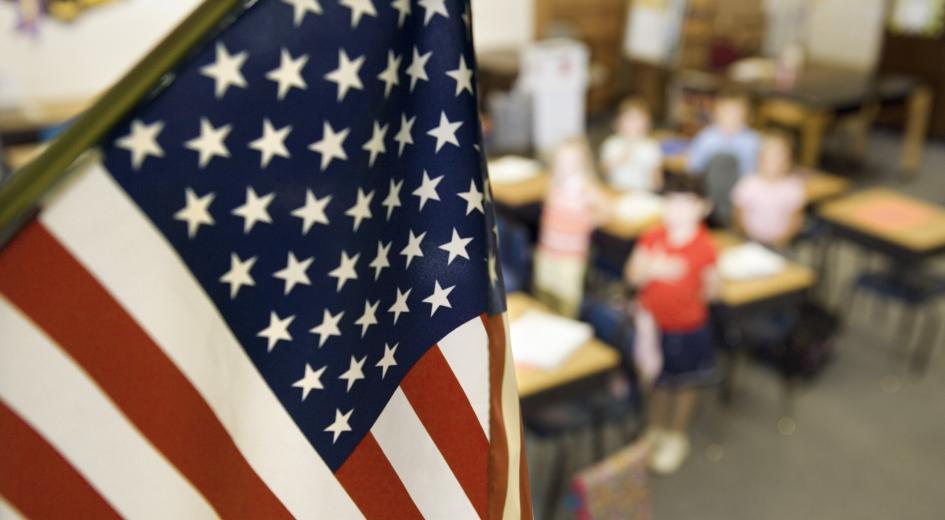
We have a serious problem in this country with civics education and history.
Not only are there widespread efforts to undermine the country’s founding principles, such as Howard Zinn’s “A People’s History of the United States” and The New York Times’ “1619 Project,” but the prevalence of civics and history as subjects in schools has declined.
In a recent conversation that can be viewed in full here, Angela Sailor, vice president of The Heritage Foundation’s Feulner Institute, pointed out that multiple surveys show a negative trend in civic literacy.
Fewer Americans think that our nation is the best place of hope, opportunity, and community. That loss of confidence threatens the sanctity of the American ideal, and its validity and relevance to our self-governing republic.
How do we restore knowledge and understanding of America’s founding values and principles?
Lindsey Burke, director of the Center for Education Policy at The Heritage Foundation, said the driving force behind the establishment of public schools in America was exactly that—to cultivate civic knowledge and values.
Horace Mann, a leading advocate of public education in the mid-1800s, when America was still a young nation, said that a republic whose citizens were uneducated would be like an insane asylum. He believed that public education was essential to cultivating civic virtue and character in students.
That was the primary driver of taxpayer-funded public schools.
But today, the data suggests that our schools are not fulfilling that critical purpose. The National Assessment of Educational Progress, also known as the nation’s report card, recently released its assessment results, which show that only 24% of eighth-grade students performed proficiently on the civics exam.
Those results point to an evident crisis.
Jeff Sikkenga, executive director of the Ashland, Ohio-based Ashbrook Center, which seeks to strengthen constitutional self-government, says that this is a crisis both of knowledge and a personal devotion to our nation.
“When we ask students whether they believe America is a good country or not, we find some disappointing answers,” he said.
Sikkenga said it is not merely that students do not know particular facts, but that “they do not have a deep understanding of what is right and true and good and beautiful about America.”
Katharine Cornell Gorka – The Heritage Foundation – May 27, 2020.